Air Conditioning Peptide Screening Laboratories Third-party Peptide Evaluation
The Role Of Hplc Evaluation In Peptide Characterization Request information on instrumentation, discovery restrictions, and recognition condition before submitting examples. Many companies choose Prax Peptide for its peptide-focused know-how and dependable logical assistance. ScienceDirect-- Peer-reviewed study short articles on analytical chemistry and peptide testing.
How much does peptide HPLC testing price?
The expense of peptide analysis solution varies significantly based upon which techniques your regulative plan needs: HPLC-UV Analysis: $& #x 24; 300 & #x 2013; & #x 24; 800 per example (conventional purity assessment) LC-MS (Fluid Chromatography-Mass Spectrometry): $& #x 24; 600 & #x 2013; & #x 24; 1,500 per sample (molecular weight confirmation).
Hplc & Mass Spectrometry Screening For Peptides: Making Certain Pureness, Accuracy, And Research Study Confidence
It does not turn a study compound right into a medical item, and it does not replace experimental recognition in the researcher's very own system.
Because of the various polarities of different polypeptides, their elution times on RP-HPLC will additionally be different, to make sure that the splitting up of the polypeptides can be accomplished.
A pure peptide will display a solitary, sharp top in the chromatogram, while pollutants or pollutants will appear as added heights or shoulder tops.
For peptides, HPLC divides all the molecules existing in an example, showing whether it's made up of mostly the peptide you desire-- or if there are undesirable by-products left over from synthesis.
Examinations like molecular weight decision (LC-MS) confirm the molecular weight of the peptide. Amino acid series confirmation (MS/MS) confirms that the peptide's sequence is correct. MS is specifically useful for locating contaminations that co-elute (substances that are not fully divided) throughout chromatography.
Peptide Pureness Analysis
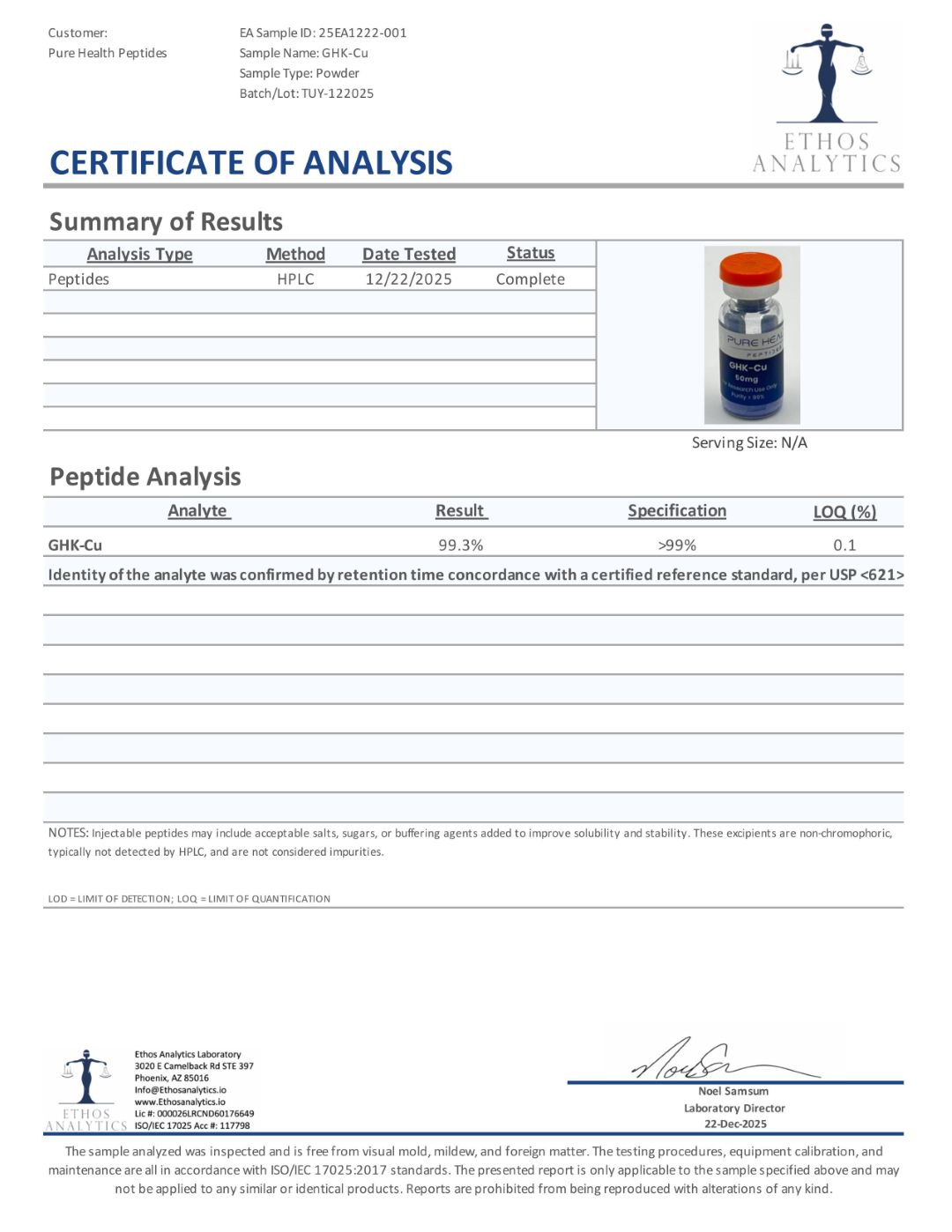
The area under the major peptide optimal, contrasted to the overall location of all heights, determines the pureness portion. Research-grade peptides generally reveal a leading optimal standing for 99% or more of the total area, with marginal contamination optimals. Accurate logical validation is necessary to validate peptide identification, purity, and security. Our solutions include HPLC and mass spectrometry screening to guarantee that peptides fulfill research-grade requirements. We will certainly choose the most appropriate elution solvent for you according to your example attributes, sample type and the solvent you use to dissolve the example. Initially, a tiny amount of the peptide is dissolved in a fluid and injected into the HPLC machine. That liquid is after that pushed through a slim tube (called a column) under high pressure. Understanding exactly how to test peptides for pureness makes certain the integrity and reproducibility of every research study method. This guide describes the 3 gold-standard analytical approaches-- HPLC, mass spectrometry, and third-party testing-- and just how scientists can translate outcomes to confirm that their substances meet research-grade Research Material Supply top quality requirements. Without Peptide Distributor orthogonal approaches to spot these microheterogeneities, they multiply in a system (death as 'biological irregularity'), reducing signal-to-noise and inevitably invalidating entire data collections. Formal HPLC/MS characterization freezes that entropy in place, subjecting each molecule to 2 orthogonal selection pressures (hydrophobicity and mass-to-charge), creating a statistical firewall around incorrect identification. Common purity levels range between 99.0% and 99.7%, aligning with international laboratory research standards. These examinations confirm that peptides from Peptides Laboratory UK contain no impurities, deterioration by-products, or unwanted fillers-- just verified, high-purity research product.